

The Integrity Question: Inside the WRTC 2026 Multiplier Investigation
Public log analysis has raised serious questions about suspected pirate callsigns, disputed multipliers, and how the world’s premier radiosport competition should respond.


When the closing ceremony ended at the World Radiosport Team Championship (WRTC 2026), there was every reason to believe the championship had become another success story in the history of radiosport. After years of planning by dozens of volunteers, fifty identical stations had been constructed across the English countryside, competitors from around the world had operated under remarkably equal conditions, and one of the closest finishes in WRTC history had produced worthy champions. The organizers deserved praise, the volunteers received a standing ovation, and the competitors began making their way home believing the event had reached its conclusion.
It had not.
Like many major contests, WRTC entered a second phase once the operating stopped and the logs became public. Competitors naturally reviewed their own performance, compared operating decisions with friends, and studied rate sheets, multiplier strategy, and the countless decisions that separate the winners from the rest of the field. Q5 Ham Radio covered much of that conversation through interviews with many of the event’s top competitors, including Randy Thompson K5ZD, Christopher Hurlbut KL9A, Daniel Craig N6MJ, Emir “Braco” Memic E77DX, Sven Lovric DJ4MX, Filipe Lopes CT1ILT, Dave Kucelin 9A1UN and Kristjan Kass ES7A.


But for experienced contest operators, the learning rarely stops with their own logs. One of the enduring traditions of competitive contesting is the careful study of competitors’ publicly available logs, searching for insights into band changes, operating rhythm, multiplier strategy, and the countless small decisions that can determine a world championship. This time, however, they found something unexpected. Alongside the usual lessons were patterns that many of the sport’s most accomplished operators considered difficult to explain and worthy of much closer examination.
What followed was neither a rumor nor a social media pile-on. It was an investigation conducted almost entirely by WRTC competitors and referees who have spent decades studying contest logs because that is how elite contesters improve. They compared logs, reconstructed timelines, analyzed multiplier distributions, debated propagation, reviewed Reverse Beacon Network data, challenged one another’s assumptions, and openly corrected one another when better explanations emerged. Their discussions unfolded in public on the WRTC2026 Groups.io reflector, allowing others to test, question and refine the analysis as new information became available.
Few participants who carefully reviewed the data continued arguing that nothing unusual had occurred. As more logs were examined and more independent analyses were completed, the discussion gradually shifted. The question was no longer whether the pattern deserved investigation. It was what that investigation ultimately meant for the integrity of the championship.
The Unseen Competitor? If the public analyses ultimately prove correct, the greatest threat to WRTC 2026 may not have come from inside a competitor's tent, but from an unidentified pirate operator who compromised the integrity of the competition.
The discussion began with observations from Alex Avramov LZ4AX who published an analysis of ten callsigns that appeared throughout the WRTC logs under circumstances he believed were sufficiently unusual to warrant closer examination. Those callsigns were YV1LBB, 4F3OM, 4S7KM, HZ1TT, 4K6FO, TI1W, HC5AI, HL2CFY, 9M8YY and 9M2LAN. Examining publicly available contest logs, LZ4AX noted several characteristics they appeared to share. All operated CW only. None submitted a log to the IARU HF World Championship. None appeared to establish and hold a running frequency. Instead, they seemed to move through the WRTC field making relatively few contacts, and providing somewhat rare multipliers.
It would have been easy to overstate those observations. LZ4AX did not. In fact, one reason his analysis immediately attracted serious attention was because of what he refused to claim. He did not assert that the stations were fake. He did not claim the callsigns had definitely been pirated. He did not accuse competitors of coordinating with an outside station, nor did he speculate about motive. He repeatedly wrote some version of the same answer: I don’t know. He even acknowledged the possibility that someone could have staged the activity specifically to cast suspicion on certain teams. What concerned him was not that he possessed all the answers. It was that the available evidence raised questions that deserved answers.
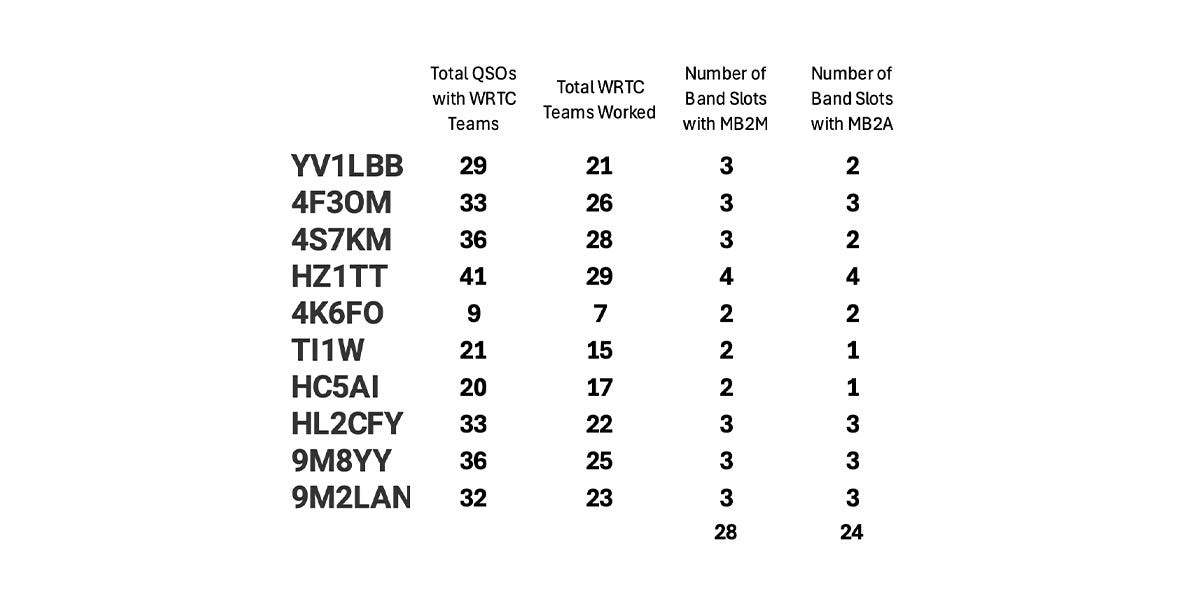
His initial multiplier analysis explained why the issue could not simply be dismissed as statistical curiosity. Across the original ten suspected callsigns, LZ4AX counted twenty-eight band multipliers credited to eventual champion MB2M and twenty-four credited to MB2A. The next-highest team outside those two had only eleven, while runner-up MB5O, despite recording the highest QSO total among the leading teams, received only a single multiplier from the same group of rare multiplier stations. In LZ4AX’s view, the disputed contacts were numerous enough that they could plausibly influence the final standings in a championship decided by remarkably small margins.
Note: Alex LZ4AX's preliminary analysis, originally posted to the WRTC2026 Groups.io reflector on July 21, is reproduced in full as Exhibit A at the end of this article for readers who wish to review the original source material.
Mirko Jurman 9A6KX a respected competitor and referee, independently reached a similar conclusion. "I did a similar analysis yesterday and despite being shocked wanted to do another one to be sure of the data, but you are pointing out the same thing... there is some difference in the multiplier list, especially 9H1FL, OD5NZ and XE2IF stations, which is 6 mults in total to MB2M and 7 to MB2A, meanwhile 0 mults for MB5O, MB1I... here's the table I got as a picture."
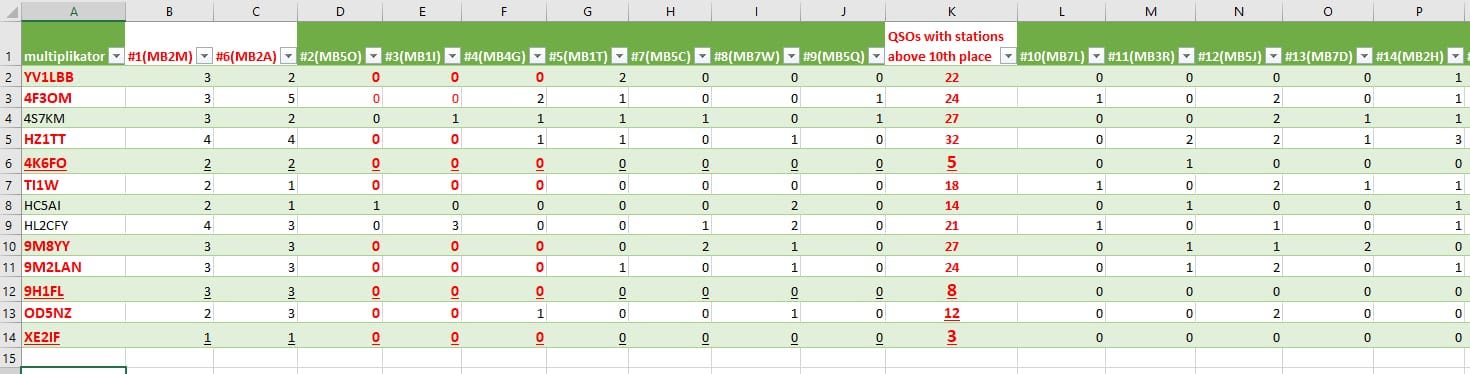
The multiplier distribution was compelling, but not conclusive. Elite contest operators routinely outperform the field when chasing multipliers. They recognize opportunities more quickly, make better decisions under pressure, and are often more successful persuading rare stations to change bands. Standing alone, an uneven multiplier distribution cannot distinguish extraordinary operating from outside influence. LZ4AX understood that as well as anyone. His analysis was not offered as a conclusion. It was an invitation to investigate further.
Other experienced operators accepted that invitation. Some attempted to explain the distribution through operating skill alone. Others wondered whether propagation or timing had created unusual opportunities for certain teams. Still others began examining the same contacts from an entirely different perspective. Instead of asking who received the multipliers, they asked when every one of those contacts occurred.
That decision fundamentally changed the discussion.
In addition to looking at statistics, Tim Shoppa N3QE reconstructed the suspected contacts into a single chronological reverse log using the publicly available WRTC competitor logs. Read from beginning to end, the reconstruction no longer resembled a collection of unrelated DX stations appearing naturally throughout the contest. It appeared to tell a story.
That story, and the chronology behind it, added an important new dimension to the investigation.
Part II: The Chronology That Changed the Discussion
The statistics compiled by LZ4AX raised an obvious question. Were the unusual multiplier distributions simply the product of chance, or did they reflect something more? Tim Shoppa N3QE approached the problem from an entirely different direction.

Rather than beginning with scores or multiplier totals, Shoppa started with time.
Using the publicly available WRTC competitor logs, he reconstructed every contact involving the ten callsigns identified by LZ4AX and arranged them into a single chronological log. As additional suspected callsigns were identified, the reconstruction grew from ten callsigns to twelve with the addition of ZP5KO and ZS6WAR. All twelve represented rare multipliers, and none submitted a log to the IARU HF World Championship.
Shoppa was careful to describe his work as an ongoing reconstruction rather than a final conclusion. Other operators continued searching for additional callsigns that might fit the same pattern, and he acknowledged that further analysis could expand or refine the chronology. Nevertheless, when the contacts were arranged chronologically instead of being grouped by callsign or by team, the resulting sequence immediately stood out.
The reconstruction did not resemble twelve unrelated DX stations independently searching the bands. Instead, it appeared to show one station working WRTC competitors, disappearing for only a few minutes, then reappearing under an entirely different callsign identity.
Rather than summarize the chronology, it is more useful to examine it directly. The following excerpt, taken from N3QE's reconstruction of the publicly available WRTC logs, illustrates why the sequence of contacts became a focus of the investigation.
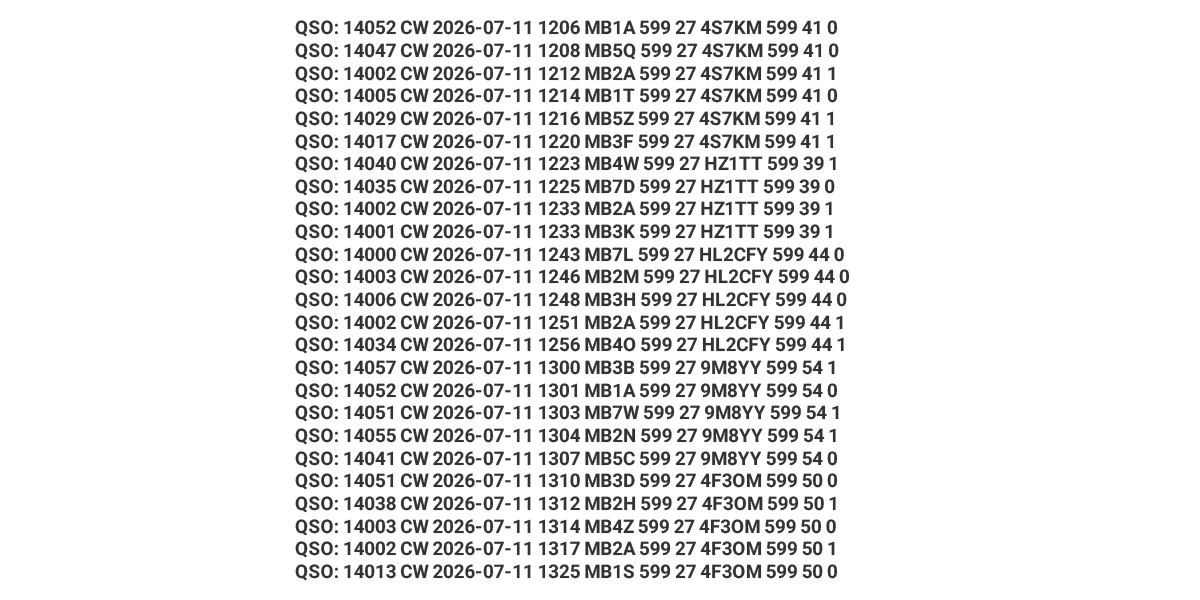
Note: Tim N3QE’s chronological analysis, originally posted to the WRTC2026 Groups.io reflector on July 22, is reproduced in full as Exhibit B at the end of this article for readers who wish to review the original source material.
Reading the chronology from beginning to end explains why the discussion accelerated. A callsign from Sri Lanka would appear briefly, only to disappear and be replaced by Saudi Arabia. Minutes later, the apparent station would become South Korea, then East Malaysia, then the Philippines, then West Malaysia. Throughout the contest the pattern continued, with the suspected operator moving from one rare multiplier to another while making contacts with WRTC competitors. What had initially appeared to be isolated statistical anomalies now looked, at least to many experienced observers, like a continuous operating sequence.
Shoppa ultimately concluded that the chronology was consistent with a single station using multiple callsigns, a conclusion that extended well beyond LZ4AX’s original statistical observations.
The chronology did not settle the debate.
It changed the debate.
Before Shoppa’s reconstruction, the discussion centered on unusual multiplier distributions. Afterward, the conversation shifted to a much more fundamental question: whether the sequence itself could reasonably be explained as twelve unrelated stations operating independently, or whether it represented evidence of a single operator changing identities throughout the contest.
Part III: What Should WRTC Do?
By the time Tim Shoppa completed his chronology, the discussion had evolved well beyond identifying suspicious callsigns. The public logs had been examined from multiple perspectives, additional suspected callsigns had been identified, and a growing number of experienced contest operators agreed that the contact sequence deserved serious attention. The question was no longer simply what had happened. Increasingly, the discussion became whether the championship should respond.

No one advanced that argument more forcefully than Alex Tkatch KU1CW.
Unlike LZ4AX, whose work focused on identifying anomalies, or N3QE, who reconstructed the chronology, KU1CW concentrated on the implications for the official results. His central argument was straightforward. If the disputed contacts involved pirated callsigns or otherwise illegitimate transmissions, then they should not remain in the final scores simply because the competitors who worked them may have acted in good faith. In his view, preserving the integrity of the championship required separating two very different questions: whether competitors knowingly did anything wrong, and whether the contacts themselves were valid.
One of KU1CW’s recurring observations centered on what he described as the “multiplier cliff.” Looking beyond the chronology itself, he examined how frequently the suspected callsigns appeared in individual logs. The pattern was striking. Two teams, MB2M and MB2A, had worked the suspected callsigns far more often than anyone else. After those two, the numbers dropped sharply. That abrupt decline became, in KU1CW’s view, one of the strongest statistical arguments that the disputed contacts had not been distributed in a manner consistent with ordinary contesting.
Whether one agreed with his interpretation or not, the underlying distribution was difficult to ignore. Eventual champion MB2M logged twenty-nine QSOs with the suspected callsigns. MB2A logged twenty-six. The next highest totals were twelve. Meanwhile, eventual runner-up MB5O, despite posting the highest overall QSO total among the leading teams, received only a single disputed multiplier. Those figures did not establish why the contacts occurred, but they became central to the debate over whether the distribution could reasonably be explained by operating skill alone.
Alex KU1CW argued that the issue extended beyond statistics. Once evidence emerged suggesting that at least some contacts may have involved illegitimate stations, WRTC had an obligation to determine whether those contacts should remain part of the official results. He rejected the notion that final standings should become effectively immune from review simply because the contest had ended.
That position shifted the discussion into unfamiliar territory. For decades, contest sponsors have corrected logs, adjusted scores, and occasionally disqualified competitors when evidence of rule violations emerged. What made the WRTC discussion different was that the suspected misconduct, if misconduct had occurred at all, appeared to originate outside the competing stations themselves. If a pirate operator transmitted false identities and competitors unknowingly logged those contacts, who should bear the consequences?
There was no consensus.
Some participants argued that competitors who acted in good faith should never lose credit for contacts they had every reason to believe were legitimate. Others countered that the purpose of adjudication is not to assign blame but to determine the most accurate result possible. If a contact never should have counted in the first place, they argued, then allowing it to remain in the final scores simply because the competitor was unaware of the deception created a different kind of unfairness—one suffered by every team that did not receive the same opportunity.
KU1CW never argued that competitors should be judged guilty by association. His focus remained on the contacts themselves. In his view, determining whether those QSOs were legitimate was not an attack on the competitors who logged them. It was an essential step in preserving confidence in the championship.
By this stage, the investigation had moved well beyond discovering suspicious callsigns or reconstructing a timeline. It had become a debate over first principles: What is the obligation of a world championship when credible new evidence emerges after the medals have been awarded? Should the pursuit of the most accurate result outweigh the value of finality? Or should uncertainty, no matter how troubling, remain part of the accepted imperfection of contest adjudication?
Those questions would soon draw responses from competitors, organizers, and others who believed the future reputation of WRTC itself was now at stake.
Part IV: Finality or Fairness?
If KU1CW represented the strongest argument for reopening the results, he was far from alone in believing the issue had grown beyond a statistical exercise. As the discussion continued, more competitors weighed in. Few disputed that the public log analysis had uncovered something unusual. The disagreement centered on a more difficult question: what should happen next?
One school of thought argued that the integrity of a world championship demanded a formal review regardless of where the evidence ultimately led. Their reasoning was simple. WRTC exists because competitors trust that identical stations, impartial referees, and rigorous adjudication produce the fairest possible result. If credible evidence later suggests that outside interference may have influenced the outcome, then examining that evidence is not optional. It is part of the same commitment to competitive fairness that defines the event itself.
Others viewed the situation differently.
They pointed out that no public evidence demonstrated that any competitor knowingly worked a pirate station, coordinated with an outside operator, or violated the rules of the competition. Every contested QSO had been made in real time under normal contest conditions. Referees observed the operating positions, the contacts appeared in the logs, and the competitors had no practical way to determine whether a rare station calling them was genuine or using a stolen identity. Removing contacts after the fact, they argued, risked penalizing competitors for circumstances entirely outside their control.
That distinction became central to the debate.
The investigation had increasingly focused on the legitimacy of the contacts themselves. The defense of the results focused instead on the legitimacy of the competitors’ actions. Those are not the same question.
One asks whether the QSOs should count.
The other asks whether the operators deserved to be blamed.
For many participants, the answer to the second question was straightforward. There was no public evidence that any competitor knowingly violated the rules. That conclusion, however, did not necessarily resolve the first.
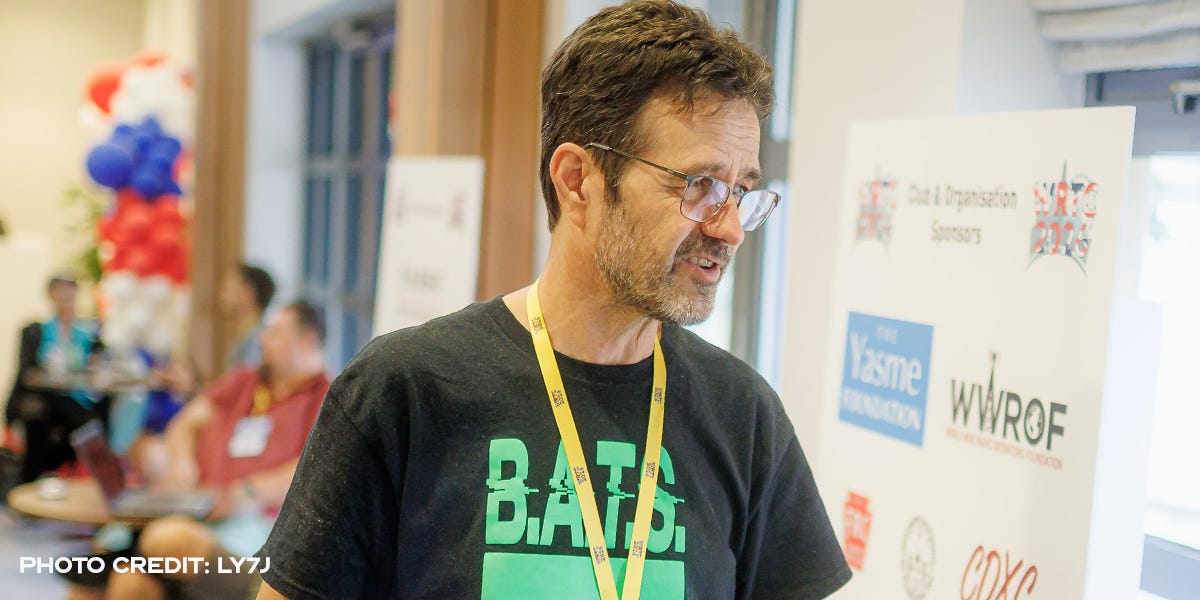
Perhaps the clearest expression of that concern came from Uli Ann DM5EE. Rather than argue for immediate changes to the standings or dismiss the investigation outright, he drew a distinction between accepting the published results and protecting the long-term credibility of the event. Competitors, he wrote, had accepted the judges’ decisions as final, but the organization itself now had a responsibility to consider what the investigation meant for WRTC’s reputation. The issue, in his view, extended beyond who stood on the podium in England. It touched the confidence future competitors would place in the championship itself.
Others echoed that sentiment while emphasizing patience. “Tree” Tyree N6TR, a member of the WRTC 2026 Judging Committee, reminded participants that much of the work was occurring outside public view, writing that “LOTS of activity” was taking place behind the scenes and suggesting that many of the proposals raised publicly were already being examined. Rather than encouraging speculation, he urged participants to allow the review process to run its course.

Filipe Lopes CT1ILT approached the issue from the perspective of someone who has competed at the highest levels of international contesting. While careful not to prejudge the outcome of the investigation, he argued that protecting confidence in WRTC required following the evidence wherever it led. In his view, competitors owed that not only to those who stood on the podium in 2026, but also to every future team that would invest years preparing for a championship built on the principle of equal opportunity. Ignoring credible questions simply because they were uncomfortable risked creating more lasting damage than a careful review ever could.
Like several others, Filipe emphasized that transparency should not be confused with accusation. Examining the evidence did not imply that competitors had acted dishonestly. Rather, it reflected the same analytical culture that has always defined elite contesting, where operators routinely scrutinize logs, challenge assumptions, and pursue the most accurate understanding of what actually occurred.
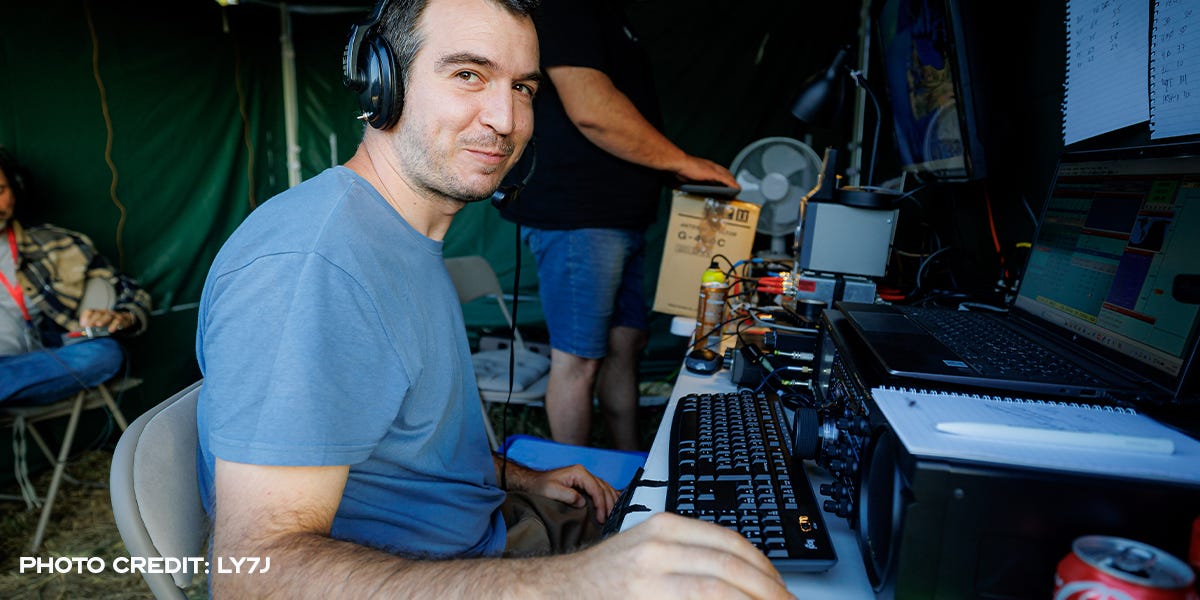
Mirko Jurman 9A6KX offered another important perspective. Having served both as a world-class competitor and as a referee, he understood the pressures facing organizers as well as the expectations of the competitors themselves. He cautioned against rushing to conclusions while also recognizing that the questions raised by the public analyses could not simply be ignored. Whatever the final determination, he argued, WRTC’s credibility depended on demonstrating that serious concerns would receive a serious, methodical review.
That viewpoint reflected a recurring theme throughout the discussion. Many participants were less concerned with whether the investigation ultimately altered the standings than with whether the process itself inspired confidence. For an event whose reputation rests on fairness and equal conditions, the willingness to examine difficult evidence openly had become almost as important as the conclusions eventually reached.
Not everyone believed patience was enough.

Emir “Braco” Memic E77DX, the third place finisher, argued that public discussion itself had become part of preserving the sport’s integrity. Without the willingness of competitors to examine the logs, compare analyses, and ask uncomfortable questions, he suggested, the issue might never have come to light. Whether or not the investigation ultimately changed the results, transparency had already become one of its most significant outcomes.

As this article was being finalized, the investigation continued to evolve as additional operators contributed technical observations and new avenues for independent verification. WRTC competitor Manfred Wolf DJ5MW pointed investigators to the University of Graz WebSDR archive, which continuously records and preserves the amateur radio spectrum for approximately two weeks. By selecting the contest date, band, time, frequency, and mode, investigators can replay and listen to transmissions made using the suspected pirated callsigns, allowing independent review of the signals that prompted the investigation. Manfred also observed that several of the rare callsigns involved in the disputed contacts appeared unusually strong on 40 meters at the Austrian receiver.
Perhaps the most striking aspect of the discussion was what it did not become.
Despite strong opinions, relatively few experienced participants dismissed the evidence outright. The disagreement was not primarily over whether the chronology deserved attention. It was over what standard of proof should be required before altering the outcome of a world championship. Some believed the evidence justified reopening the adjudication process. Others believed it justified a thorough investigation while leaving the published standings intact unless additional evidence emerged. Still others argued that, regardless of the conclusions reached in 2026, the lessons should be used to strengthen future WRTCs against similar manipulation.
In that sense, the controversy had already expanded beyond the twelve suspected callsigns.
It had become a debate about how the sport defines competitive integrity when technology, public log analysis, and collaborative investigation reveal questions that could not have been asked—or answered—a generation earlier.
Part V: The Decision Ahead
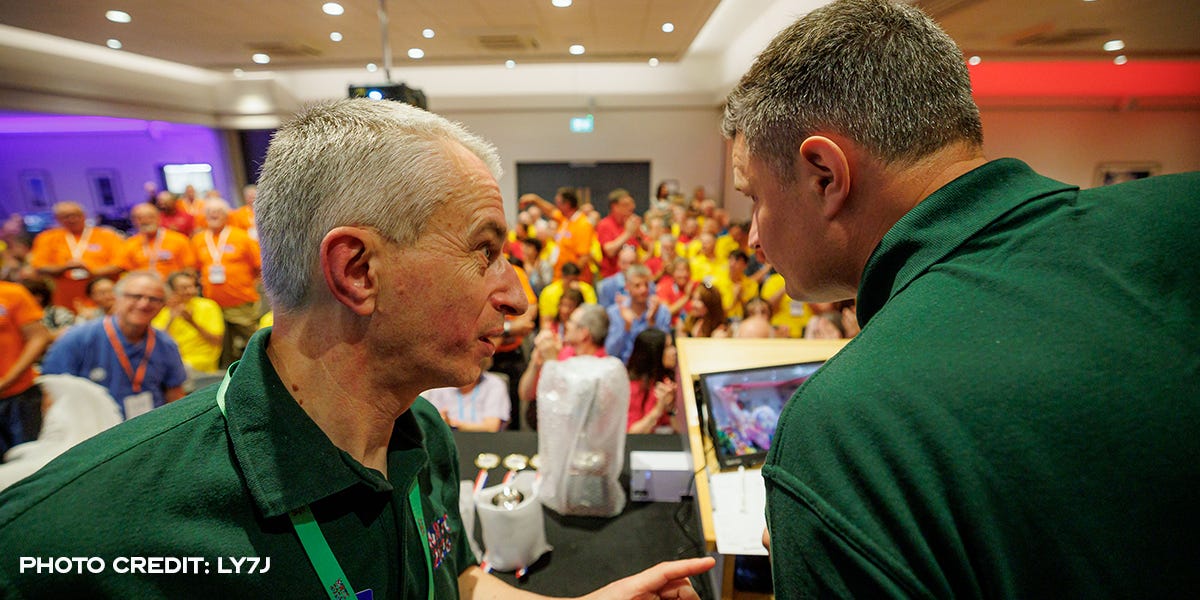
As of publication, Q5 understands that WRTC 2026 Chairman Mark Haynes M0DXR is reviewing the analyses that have emerged from competitors and independent investigators. Even as this article was being finalized, additional analysis continued to emerge, underscoring that the investigation remains active and that conclusions continue to be refined as new evidence is examined. The review has also benefited from independent technical analyses by Bill Fehring W9KKN and Tim Shoppa N3QE, both widely respected for applying statistical and software-based analysis to contest data. Those discussions are expected to include members of the WRTC Organizing Committee, Judging Committee, and potentially the WRTC Sanctioning Committee as they determine whether further review is warranted and, if so, whether any action should follow.
Whatever conclusions those discussions ultimately reach, the decision will extend well beyond the final standings of WRTC 2026. The questions raised over the past days have challenged long-held assumptions about how major radiosport competitions respond when credible new evidence emerges after the contest has ended. They have also demonstrated the remarkable analytical depth of the contesting community itself. Through careful examination of publicly available logs, experienced competitors reconstructed timelines, tested competing theories, challenged one another’s conclusions, and, in many cases, refined their own thinking as new evidence came to light.
Whether the published results remain unchanged or additional action is taken, WRTC now faces an opportunity to reinforce the principles on which the championship was built. Competitors, volunteers, sponsors, and spectators alike deserve confidence that serious questions will receive a serious review, that decisions will be grounded in evidence, and that the process itself will inspire trust.
The medals have already been awarded. The lasting legacy of this controversy may not be who won WRTC 2026, but how the championship chose to respond when its integrity was questioned. For the sake of radiosport, one can only hope that process is both transparent and timely.
Has anyone considered contacting the owners of the suspected call signs? They should be able to provide valuable information if they were or were not in the contest.
There are some additional things that could be done to check on these results.
If there are significant numbers of RBN reports of the suspect stations, they could be examined to see whether the pattern of RBN reception is consistent with the supposed locations of the stations.
Another would come into play if there are any aircheck recordings of the QSOs with the suspect stations. Transmitters have distinct signatures that can be identified; rise and fall times, key clicks, lengthening or shortening of code elements, and so forth. If multiple suspect callsigns came from a single pirate operator, it might be possible to identify that.
The fact that the pirates (if that's what they are) only operated on CW adds to the level of suspicion. They might have avoided SSB because it would have been too difficult to disguise that a single operator was responsible.